How to use this material
Exam Tags & Source: Syllabus mapping for UPSC / TNPSC / SSC-RRB + clickable source link
Why in News: The news in 2–3 lines – read this first
▸ Sub-headings: Simple explanation + all facts, figures, names and years
GS Facts: Static GK linked to the news (blue box)
⚠ Exam Trap: Common confusions examiners use in options (orange box)
✍ Mains Angle: Probable Mains question with value points (purple box)
✎ Top 5 Quiz: Day’s 5 most important MCQs at the end – play the quiz, see answers instantly and check your rank on the leaderboard
★ Important One-liners: Short news under each theme + Rapid Revision
Here are the daily current affairs of 27 November 2026 in English for UPSC, TNPSC, SSC, RRB and Bank exams: India’s record foodgrain output of 378.54 MT in 2025-26, the eSankhyiki portal, India’s 40th rank in the AI-Human Skills Synergy Index, SpaceX’s Starmind orbital data centres, the 14th India–UAE JDCC, GLOF Sanjivani in Nepal, three repatriated Chola and Vijayanagara bronzes, 15 days of paternity leave in Tamil Nadu and the BIMSTEC Under-23 Athletics Meet. Each topic comes with exam tags, GS facts, exam traps, a Mains angle, a rapid revision table and an interactive Top 5 Quiz with a leaderboard – useful for UPSC, TNPSC, SSC, RRB and Bank exams.
Quick Answer – Top Current Affairs Today (27 Nov 2026)
- Foodgrain output: final estimates for 2025-26 show a record 378.538 million tonnes (MT) – up 20.806 MT from 357.732 MT; Kharif 2026-27 first advance estimate: 167.143 MT.
- eSankhyiki: MoSPI’s one-stop official-statistics portal – 43 products, 1,109 datasets, 139 million+ records.
- AI-Human Skills Synergy Index: Coursera’s Global Skills Report 2026 ranks India 40th of 98 countries (12th in Asia-Pacific).
- Starmind: the US FCC approved SpaceX’s plan for up to 1 million orbital AI data centres; deployment to start by November 2033.
- India–UAE JDCC: the 14th Joint Defence Cooperation Committee met in Abu Dhabi (26 Nov 2026) – focus on co-development and co-production.
- GLOF Sanjivani: Nepal–UNDP US$ 49.94 million project (2026–2033) to cut glacial lake flood risk in four lakes.
- Repatriated bronzes: ASI handed three Chola and Vijayanagara bronzes (Sundarar, Kannappa Nayanar, Somaskanda) to the TN Idol Wing CID.
- Also in news: TN 15-day paternity leave; Colombo Security Conclave Roadmap 2026-27; Elias 2-24 b (youngest known planet); BIMSTEC U-23 Athletics Meet; new Meghalaya geckos; WOAH PVS evaluation of aquatic animal health.
ECONOMY
★ Important One-liners
- ESANKHYIKI – MOSPI’S ONE-STOP PORTAL FOR OFFICIAL STATISTICS:Source: PIB ↗The Ministry of Statistics and Programme Implementation (MoSPI) runs eSankhyiki – a one-stop window for official statistics.Aim: let users easily find, download and reuse government data.Features: search datasets, interactive visualisations of indicators, metadata (details of how data was collected), downloads in machine-readable formats and APIs (Application Programming Interfaces) – which let other apps pull the data directly.Scale now: 43 statistical products, 1,109 datasets, over 139 million records.Linked scheme: VISTAR – Viksit Bharat Initiative for Statistical Transformation, Analytics & Research – focuses on sub-national (State/district) statistics and digital tools; its ‘Support for Statistical Strengthening’ component helps States.Static: eSankhyiki launched June 2024; MoSPI’s two wings – Statistics Wing (NSO – National Statistics Office) and Programme Implementation Wing; data like GDP, CPI inflation, IIP, PLFS (Periodic Labour Force Survey).
AGRICULTURE
Record Foodgrain Output of 378.54 Million Tonnes in 2025-26 (Final Estimates); Kharif 2026-27 First Advance Estimates Released
Why in News: Agriculture Minister Shivraj Singh Chouhan released the final crop estimates for 2025-26: an all-time high foodgrain production of 378.538 million tonnes (MT) – up 20.806 MT from 357.732 MT (2024-25). He also released the first advance estimates for Kharif 2026-27 – 167.143 MT.
2025-26 final estimates – crop-wise
| Crop | 2025-26 (MT) |
|---|---|
| Total foodgrains | 378.538 (record) |
| Rice | 155.154 (record; 150.184 in 2024-25) |
| Wheat | 122.064 (record; +4.119) |
| Maize | 55.025 (43.409 in 2024-25 – big jump) |
| Total pulses | 27.240; moong record 4.396 |
| Total oilseeds | 43.255 (record) |
| Groundnut / Rapeseed-mustard | 13.171 / 13.766 (record) |
| Sugarcane | 503.729 |
| Cotton | 28.006 million bales (1 bale = 170 kg) |
| Jute & mesta | 94.28 lakh bales (1 bale = 180 kg) |
Kharif 2026-27 – first advance estimates
- Foodgrains: 167.143 MT – 9.767 MT above the average kharif output of the previous five years
- Rice: 121.905 MT; nutri and coarse cereals: 38.105 MT (maize 26.064, bajra 8.943)
- Pulses: 7.132 MT; oilseeds: 23.947 MT (groundnut 11.168, soybean 10.244)
- Weather stress: El Niño, delayed monsoon onset, 35–40% rain deficit in several regions; drought-like conditions in Maharashtra, Karnataka, Telangana, Andhra Pradesh hit paddy, maize, tur, soybean, cotton sowing
India’s global position
- 1st in the world: Rice, pulses, jute, millets and spices
- 2nd in the world: Wheat and cotton (after China)
- Policy focus now: With large wheat and rice stocks, focus is on self-reliance in pulses and edible oils through crop diversification – National Pulses Mission and National Oilseeds Mission
- Exports: Rice exports up 5%; basmati gaining markets in the USA, Canada and West Asia
GS Facts
- Crop estimates are released by the Directorate of Economics & Statistics (DES), Ministry of Agriculture – 4 advance estimates + final estimates each year
- Kharif crops – sown with the monsoon (June–July), harvested Sept–Oct (rice, maize, bajra, tur, soybean, cotton, groundnut)
- El Niño – warming of the central/eastern Pacific Ocean, usually weakens the Indian monsoon
- National Mission on Edible Oils – Oilseeds (NMEO-Oilseeds) – approved Oct 2024 (2024-25 to 2030-31)
- Mission for Aatmanirbharta in Pulses – announced in Budget 2025-26 (focus on tur, urad, masoor)
⚠ Exam Trap
- 378.538 MT is the final estimate of 2025-26; 167.143 MT is only the first advance estimate of kharif 2026-27 – don’t mix.
- India is 2nd (not 1st) in wheat and cotton.
- Cotton is measured in bales of 170 kg, jute in bales of 180 kg.
✍ Mains Angle
Q. Record foodgrain output has not solved India’s dependence on imported pulses and edible oils. Examine and suggest measures for crop diversification.
Value points: Cereal surplus (378.5 MT; large FCI stocks) vs edible-oil imports (~55–60% of need) and pulse imports; MSP & procurement bias towards rice/wheat; water stress (Punjab, Haryana); NMEO-Oilseeds, Pulses Mission, PM-AASHA; price assurance, seeds, irrigation, climate-resilient varieties; El Niño risk management.
★ Important One-liners
- WOAH BEGINS EVALUATION OF INDIA’S AQUATIC ANIMAL HEALTH SERVICES:Source: PIB ↗The Department of Fisheries (Ministry of Fisheries, Animal Husbandry and Dairying) began the World Organisation for Animal Health (WOAH) Performance of Veterinary Services (PVS) Evaluation of India’s Aquatic Animal Health Services (AAHS) with an orientation meeting at the National Agricultural Science Complex (NASC), New Delhi.Aim: an independent, evidence-based check of India’s fish and aquatic animal disease system, to align it with international standards and find priorities for investment. It is voluntary.Four core areas assessed: (1) human, physical and financial resources; (2) technical authority and capability; (3) stakeholder engagement; (4) regulatory capability and market access (important for seafood exports).Static: WOAH – founded 1924 as OIE (Office International des Epizooties); HQ Paris; sets standards for animal health recognised by the WTO’s SPS (Sanitary and Phytosanitary) Agreement; India – 2nd largest fish producer in the world.
SCIENCE & TECH
India Ranks 40th in Coursera’s First AI-Human Skills Synergy Index (Global Skills Report 2026)
Why in News: India ranked 40th globally and 12th in the Asia-Pacific in the inaugural (first) AI-Human Skills Synergy Index, part of Coursera’s Global Skills Report 2026 (8th edition). It shows India is learning AI fast but lagging in human skills like critical thinking and problem-solving.
About the index
- What it measures: How well learners build AI skills and human skills together, plus each country’s AI readiness
- Coverage: 98 countries; data from 300 million+ learners on Coursera and Udemy
- Weightage: 60% learning behaviour + 40% government AI readiness (uses Oxford Insights’ Government AI Readiness Index)
- Learning component: Proficiency, share of learners building both AI and human skills, and breadth of skills
India vs world – enrolment growth (year-on-year)
| Skill | India / Global |
|---|---|
| AI micro-credentials | 181% / 122% (India ahead) |
| All AI courses (India) | 57% |
| Critical thinking | 65% / 107% |
| Complex problem-solving | 55% / 126% |
| Innovation | 62% / 74% |
- Fastest-growing AI areas: AI security (+296%), agentic workflows (+238%), GenAI (+125%); GenAI enrolments at 12 per minute (6 in 2025)
- Jobs outlook: EY: GenAI could transform 38 million jobs in India by 2030; Bain & Company: AI talent shortfall of 1 million by 2027
- Recommendation: Align courses with specific job roles; assess AI and human skills together
GS Facts
- Agentic AI – AI systems that can plan and carry out multi-step tasks on their own
- Generative AI (GenAI) – AI that creates new text, images or code (e.g., large language models)
- IndiaAI Mission – approved March 2024, ₹10,371.92 crore
- India’s other skill/talent indices to remember: India Skills Report (Wheebox), WIPO Global Innovation Index (India 38th in 2025)
⚠ Exam Trap
- The index is by Coursera (with Udemy data), not WEF or UNESCO.
- India is 40th globally, 12th in Asia-Pacific.
- India leads in AI micro-credential growth (181%) but lags global growth in critical thinking and problem-solving.
SPACE
US FCC Approves SpaceX’s ‘Starmind’ – Up to 1 Million Satellites as AI Data Centres in Space
Why in News: The US Federal Communications Commission (FCC) authorised SpaceX to set up the ‘Starmind’ constellation of up to 1 million orbital data centres (satellites that work as computers in space for AI) – the first-ever authorisation of orbital compute modules.
- Idea: Satellites use solar energy to run AI computing in orbit and send processed data back to Earth – avoids land, power and cooling limits of data centres on Earth
- Orbit: Can be built in sun-synchronous orbit (SSO) or other orbits using space-based solar power
- Communication: Main links are optical (laser) inter-satellite links; backup radio-frequency links in 18.8–19.3 GHz (downlink) and 28.6–29.1 GHz (uplink) (Ka-band) – also for emergency TT&C (Telemetry, Tracking and Command)
- FCC chair: Brendan Carr – calls it a step into the ‘era of super intelligence’
Deployment deadlines
| Milestone | Deadline |
|---|---|
| Start deployment | By November 2033 |
| 10% (1,00,000 satellites) | By November 2035 |
| 50% (5,00,000 satellites) | By November 2038 |
GS Facts
- FCC – independent US agency regulating radio, TV, satellite and wire communication (India’s similar roles – TRAI and DoT)
- Sun-synchronous orbit – a near-polar LEO (~600–800 km) where the satellite passes over a place at the same local solar time daily; good constant sunlight for solar power
- Telemetry = health data sent from satellite; Tracking = finding its position; Command = instructions sent to it
- Concerns – space debris, Kessler syndrome (chain of collisions), light pollution for astronomy
⚠ Exam Trap
- Approval is by the FCC (communications regulator), not NASA or the FAA.
- Constellation name is Starmind (not Starlink, which is SpaceX’s internet constellation).
- 10% must be deployed by 2035, 50% by 2038.
★ Important One-liners
- ELIAS 2-24 B – YOUNGEST KNOWN PLANET CONFIRMED:Source: News on AIR ↗Astronomers confirmed Elias 2-24 b, a Jupiter-sized planet less than 1 million years old – the youngest known planet. It orbits a young star about 450 light-years away.Observed with the coronagraph of the W. M. Keck Observatory, Hawaii (works with NASA under a cooperative agreement). A coronagraph blocks the bright light of a star so that faint planets near it can be seen.Why important: shows planets in the early stage of formation – a glimpse of how our Solar System may have looked billions of years ago (our Solar System is ~4.6 billion years old).
DEFENCE
14th India–UAE Joint Defence Cooperation Committee (JDCC) Meets in Abu Dhabi
Why in News: The 14th meeting of the India–UAE Joint Defence Cooperation Committee (JDCC) was held in Abu Dhabi on 26 November 2026, co-chaired by Defence Secretary Rajesh Kumar Singh and Lt Gen Ibrahim Nasser M. Al Alawi, Under Secretary, UAE Ministry of Defence.
- Purpose: Gave strategic direction to the India–UAE Strategic Defence Partnership Framework, signed in May 2026 during the PM’s visit to the UAE
- Areas agreed: Defence industry, defence innovation & advanced technology, artificial intelligence, cyber, military training and maritime safety
- Key decision: Speed up co-development and co-production of next-generation defence equipment; review progress at regular intervals
- Industry: B2B (business-to-business) meeting of defence industries; Indian firms visited Tawazun Industrial Park and met the Tawazun Economic Council (UAE’s defence-industry body)
- Other meetings: Called on UAE MoS for Defence Affairs Mohamed bin Mubarak Fadhel Al Mazrouei – discussed the Gulf & West Asia situation; tribute at Wahat Al Karama (UAE’s war memorial)
- Indian delegation: Department of Defence, Armed Forces, National Security Council Secretariat, MEA
GS Facts
- India–UAE ties: Comprehensive Strategic Partnership (2017); CEPA (Comprehensive Economic Partnership Agreement) – in force 1 May 2022 (India’s first such deal in the region)
- Joint exercises: Desert Cyclone (Army), Zayed Talwar (Navy), Desert Knight (Air Force, with France)
- UAE – India’s 3rd largest trading partner; ~35 lakh Indians live there
- I2U2 (India, Israel, UAE, USA) and IMEC (India–Middle East–Europe Economic Corridor)
⚠ Exam Trap
- The JDCC is co-chaired at Defence Secretary level, not by Defence Ministers.
- The Strategic Defence Partnership Framework was signed in May 2026.
- Tawazun is a UAE defence-industry park/council, not a military exercise.
ENVIRONMENT
★ Important One-liners
- TWO NEW CAVE-DWELLING BENT-TOED GECKOS FOUND IN MEGHALAYA:Source: DD News ↗Two new species of cave-dwelling bent-toed geckos (genus Cyrtodactylus) were found in the limestone caves of Meghalaya’s Khasi and Jaintia Hills – taking the genus count in Meghalaya to nine.(1) Cyrtodactylus bossmit – named after ‘Bossmit’, Shillong’s iconic wooden bus; found at Maw Tynghiang Cave (Nongnah, South-West Khasi Hills) and Wahlong Byrong (East Khasi Hills); also linked to populations near Sohra and Umdohlun – spread across the Khasi Hills.(2) Cyrtodactylus kremicola – from the Khasi word ‘krem’ = cave; known only from Rupasor Cave, Syndai village, West Jaintia Hills.Max body length – 81.7 mm (bossmit) and 83.6 mm (kremicola). Published in the journal Taprobanica (25 Nov 2026), using morphology and molecular (DNA) analysis.Static: Meghalaya has India’s longest caves – Krem Liat Prah (longest natural cave in India) and Krem Puri (world’s longest sandstone cave).
- NEPAL–UNDP LAUNCH ‘GLOF SANJIVANI’ TO CUT GLACIAL LAKE FLOOD RISK:Source: News on AIR ↗Nepal and the UNDP (United Nations Development Programme) launched ‘GLOF Sanjivani’, a US$ 49.94 million project (2026–2033) to reduce the risk of Glacial Lake Outburst Floods (GLOFs) – sudden floods when water stored in lakes formed by melting glaciers bursts out (often when a natural moraine dam breaks), damaging villages, roads, bridges and hydropower projects.Main work: lower water levels in four lakes – Thulagi (Manang), Lumding Tsho and Hongu 2 (Solukhumbu) and Lower Barun (Sankhuwasabha) – by 3 m each (Hongu 2 by 1 m); better glacier monitoring and early warning systems.Benefit: 3.85 lakh people directly, ~20 lakh downstream.Funding: Green Climate Fund US$ 36.16 mn + Nepal 11.32 mn + UNDP 2.14 mn + private 0.32 mn.Static: Green Climate Fund (GCF) – set up 2010 under the UNFCCC, HQ Songdo, South Korea; India’s recent GLOF – South Lhonak Lake, Sikkim (October 2023) that destroyed the Teesta-III dam; NDMA GLOF guidelines – 2020.
INTERNATIONAL
★ Important One-liners
- COLOMBO SECURITY CONCLAVE ADOPTS ROADMAP OF COOPERATION 2026-27 AT MALE:Source: MEA ↗At the 8th National Security Adviser (NSA)-level meeting of the Colombo Security Conclave (CSC), hosted by the Maldives at Villa Nautica Paradise Island (near Male), members adopted a Roadmap of Cooperation for 2026-2027 and issued a joint statement on Indian Ocean security (NSA Ajit Doval had flagged ‘serious security challenges’ in the region).Five pillars of CSC: (1) maritime safety and security; (2) countering terrorism and radicalisation; (3) combating trafficking and transnational organised crime; (4) cyber security and protection of critical infrastructure and technology; (5) humanitarian assistance and disaster relief (HADR).Static: began in 2011 as a trilateral maritime security group of India, Sri Lanka and Maldives; renamed CSC in 2020; members – India, Sri Lanka, Maldives, Mauritius (2022), Bangladesh (2024); Seychelles – observer; secretariat in Colombo; founding charter signed in August 2024.
ART & CULTURE
ASI Hands Over Three Repatriated Chola and Vijayanagara Bronzes to Tamil Nadu Idol Wing CID
Why in News: The Archaeological Survey of India (ASI) handed over three repatriated bronze idols – two from the Smithsonian Museum (USA) and one from The Hague (Netherlands) – to the Idol Wing CID, Tamil Nadu Police at Dharohar Bhawan, New Delhi (ASI’s headquarters). Handover by ASI Director-General Yadubir Singh Rawat.
| Idol | Details |
|---|---|
| Saint Sundarar with Paravai Nachiyar | 16th-century, Vijayanagara period; photographed in 1956 at Sri Narisvara Shiva Temple, Viracholapuram, Kallakurichi; returned from the Smithsonian, USA |
| Saint Kannappa Nayanar | Chola period; from Arulmigu Agneeswarasamy Temple, Thirupugalur (Nagapattinam); in tribhanga pose, right hand raised towards his eye; returned from The Hague, Netherlands |
| Somaskanda (Shiva and Uma) | 12th-century Chola; photographed in 1959 at Sri Visvanatha Siva Temple, Alattur (Mannargudi taluk, Thanjavur); returned from the Smithsonian, USA |
Know the terms
- Sundarar: One of the 63 Nayanmars (Tamil Shaiva saints); one of the ‘Moovar’ – the three authors of the Thevaram hymns (Appar, Sambandar, Sundarar); Paravai Nachiyar was his wife
- Kannappa Nayanar: A hunter-devotee who, by legend, offered his own eyes to Shiva (linked to Srikalahasti) – hence the hand raised to his eye
- Somaskanda: Shiva with Uma (Parvati) and their son Skanda (Murugan) – ‘Sa-Uma-Skanda’; a favourite Chola bronze form
- Tribhanga: ‘Three-bend’ pose – body bent at neck, waist and knee
GS Facts
- Chola bronzes – made by the lost-wax (cire perdue) method; peak under the Cholas (9th–13th century)
- Swamimalai (Thanjavur) bronze icons have a GI tag
- Antiquities and Art Treasures Act, 1972 – antiquity = object at least 100 years old; export only by government
- UNESCO 1970 Convention on illicit trafficking of cultural property
- ASI – founded 1861 (Alexander Cunningham), under Ministry of Culture
- TN Idol Wing CID – set up 1983
⚠ Exam Trap
- Sundarar idol is Vijayanagara (16th c.), while Kannappa and Somaskanda are Chola.
- Only Kannappa came from The Hague (Netherlands); the other two from the Smithsonian (USA).
- Somaskanda includes Skanda – ‘Sa-Uma-Skanda’.
✍ Mains Angle
Q. Repatriation of stolen antiquities is both a legal and a cultural-diplomacy challenge for India. Discuss.
Value points: Scale of theft from TN temples; 1972 Act and UNESCO 1970 Convention; provenance research using old photo archives (1956, 1959 photographs, IFP Pondicherry); cooperation with US (Manhattan DA), Netherlands; over 600 antiquities returned since 2014; need for digital registry, temple security, faster restitution.
TAMIL NADU
Tamil Nadu Announces 15 Days of Paternity Leave for Male Government Employees
Why in News: Chief Minister C. Joseph Vijay announced (26 November 2026) 15 days of paternity leave for male Tamil Nadu government employees, after representations from employees.
- Aim: Encourage fathers to take part in childcare and support the mother – promote shared parenting
- When: Up to 15 days before delivery, or any time within 6 months after the birth
- Maternity leave in TN: Women government employees get 365 days (1 year) maternity leave; in August 2026, this was extended to the third child as well
GS Facts
- Central Government employees also get 15 days paternity leave – under CCS (Leave) Rules, 1972 (Rule 43-A); for up to two surviving children
- Maternity Benefit (Amendment) Act, 2017 – 26 weeks paid maternity leave in private sector (12 weeks for adoptive/commissioning mothers); now part of the Code on Social Security, 2020
- No law yet gives paternity leave to private-sector employees in India
⚠ Exam Trap
- TN’s new benefit is 15 days paternity leave (male employees); TN’s maternity leave is 365 days, extended to the third child in August 2026.
- The 26-week rule is under the Maternity Benefit Act (private sector).
SPORTS
★ Important One-liners
- INAUGURAL BIMSTEC UNDER-23 ATHLETICS MEET – INDIA TOPS, SABITA TOPPO WINS HURDLES GOLD:Source: DD News ↗At the inaugural (first) BIMSTEC Under-23 Athletics Meet at Kalinga Stadium, Bhubaneswar (Odisha), India stayed at the top of the medal table (30 medals after day 2; 8 golds on day 2).Sabita Toppo (Khelo India athlete, 21) won women’s 100 m hurdles gold in 13.86 s (silver – India’s Shiny Gladssia, 14.03 s; bronze – Sri Lanka’s PGMS Gunathilaka). Roshan Shaikh won men’s 110 m hurdles (14.15 s).Organised by the Athletics Federation of India, host – Odisha Department of Sports & Youth Affairs.Static – BIMSTEC: Bay of Bengal Initiative for Multi-Sectoral Technical and Economic Cooperation; formed 1997 (Bangkok Declaration); 7 members – Bangladesh, Bhutan, India, Myanmar, Nepal, Sri Lanka, Thailand; secretariat – Dhaka; BIMSTEC Charter came into force 2024.
TOP 5 QUIZ OF THE DAY
✎ Test yourself – 5 most important MCQs from the daily current affairs 27 November 2026. Pick an option to see the answer and explanation instantly, finish the quiz and check your rank on the leaderboard.
Daily Quiz Challenge
5 MCQs • instant answers • beat the clock and climb the leaderboard.
Question 1 of 5
As per the final estimates for 2025-26, India’s total foodgrain production was about:
Question 2 of 5
The ‘AI-Human Skills Synergy Index’, in which India ranked 40th, is part of a report released by:
Question 3 of 5
‘Starmind’, approved by the US Federal Communications Commission, is a constellation of:
Question 4 of 5
Which of the following is NOT a member of the Colombo Security Conclave?
Question 5 of 5
Consider the following pairs regarding the repatriated idols handed over to TN Idol Wing (Nov 2026):
1. Saint Sundarar with Paravai Nachiyar – Vijayanagara period
2. Saint Kannappa Nayanar – returned from the Smithsonian Museum, USA
3. Somaskanda – 12th-century Chola period
Which of the pairs given above are correctly matched?
🏆 Leaderboard – Top 10
| Rank | Name | Score | Time | Date |
|---|
Ranked by score, then fastest time. Scores are saved in this browser.
RAPID REVISION
| Topic | Key Fact to Remember |
|---|---|
| eSankhyiki | MoSPI one-stop statistics portal; 43 products, 1,109 datasets; APIs |
| VISTAR | MoSPI initiative – sub-national statistics & digital tools |
| Foodgrain 2025-26 | Record 378.538 MT (final); rice 155.154, wheat 122.064 MT |
| Kharif 2026-27 (1st AE) | 167.143 MT despite El Niño & delayed monsoon |
| India’s rank | 1st – rice, pulses, jute, millets, spices; 2nd – wheat, cotton |
| WOAH PVS | Evaluation of India’s Aquatic Animal Health Services; WOAH HQ Paris |
| AI-Human Skills Index | Coursera; India 40th (12th Asia-Pacific); 98 countries |
| Starmind | SpaceX; up to 1 mn orbital AI data centres; FCC approval; start by 2033 |
| Elias 2-24 b | Youngest planet (<1 mn yrs); Jupiter-size; Keck coronagraph |
| India–UAE JDCC | 14th meeting, Abu Dhabi; co-development & co-production |
| New geckos | Cyrtodactylus bossmit & kremicola – Meghalaya caves |
| GLOF Sanjivani | Nepal–UNDP; US$ 49.94 mn; 4 glacial lakes; GCF funding |
| Colombo Security Conclave | 8th NSA meet, Maldives; Roadmap 2026-27; 5 pillars |
| Repatriated bronzes | Sundarar (Vijayanagara), Kannappa (Chola, from Hague), Somaskanda (Chola) |
| TN paternity leave | 15 days for male govt employees; maternity 365 days |
| BIMSTEC U-23 Athletics | First edition, Kalinga Stadium; Sabita Toppo – 100 m hurdles gold |
FAQs – 27 NOVEMBER 2026
What are the most important current affairs for UPSC on 27 November 2026?
The top items are India’s record foodgrain production of 378.538 million tonnes in 2025-26, the Kharif 2026-27 first advance estimate (167.143 MT), India’s 40th rank in Coursera’s AI-Human Skills Synergy Index, the US FCC approval for SpaceX’s ‘Starmind’ orbital data centres, the 14th India–UAE Joint Defence Cooperation Committee in Abu Dhabi, the Nepal–UNDP ‘GLOF Sanjivani’ project, three repatriated Chola and Vijayanagara bronzes handed to the Tamil Nadu Idol Wing and Tamil Nadu’s 15-day paternity leave.
What was India’s foodgrain production in 2025-26 as per the final estimates?
India’s foodgrain production in 2025-26 was an all-time high of 378.538 million tonnes (MT), up 20.806 MT from 357.732 MT in 2024-25. Rice touched a record 155.154 MT and wheat 122.064 MT. The first advance estimate for Kharif 2026-27 is 167.143 MT, released by Agriculture Minister Shivraj Singh Chouhan. India is 1st in rice, pulses, jute, millets and spices, and 2nd in wheat and cotton.
What is SpaceX’s ‘Starmind’ constellation approved by the US FCC?
Starmind is a SpaceX constellation of up to 1 million satellites that act as orbital data centres for AI computing, powered by solar energy. The US Federal Communications Commission (FCC) gave the first-ever authorisation of orbital compute modules. Deployment must start by November 2033, with 10% (1,00,000 satellites) by November 2035 and 50% (5,00,000) by November 2038. Main links are optical (laser) inter-satellite links with backup Ka-band radio links.
What is the AI-Human Skills Synergy Index and where does India rank?
It is a new index in Coursera’s Global Skills Report 2026 (8th edition) that measures how well learners build AI skills and human skills together, along with government AI readiness. It covers 98 countries and 300 million+ learners on Coursera and Udemy, weighted 60% learning behaviour and 40% government AI readiness (Oxford Insights). India ranks 40th globally and 12th in Asia-Pacific – fast in AI micro-credentials (181% growth) but behind global growth in critical thinking and problem-solving.
What is the India–UAE Joint Defence Cooperation Committee (JDCC)?
The JDCC is the main institutional forum for India–UAE defence cooperation. Its 14th meeting was held in Abu Dhabi on 26 November 2026, co-chaired by Defence Secretary Rajesh Kumar Singh and UAE Under Secretary of Defence Lt Gen Ibrahim Nasser M. Al Alawi. It reviewed the India–UAE Strategic Defence Partnership Framework signed in May 2026 and agreed to speed up co-development and co-production of defence equipment, with cooperation in AI, cyber, training and maritime safety.
What is GLOF Sanjivani?
GLOF Sanjivani is a US$ 49.94 million Nepal–UNDP project (2026–2033) to reduce the risk of Glacial Lake Outburst Floods (GLOFs), which occur when water stored in glacial lakes bursts out. It will lower water levels in four lakes – Thulagi, Lumding Tsho, Hongu 2 and Lower Barun – and improve glacier monitoring and early warning. The Green Climate Fund provides US$ 36.16 million, and about 3.85 lakh people will benefit directly.
Which three bronzes were repatriated to Tamil Nadu in November 2026?
The Archaeological Survey of India handed over three bronzes to the Tamil Nadu Idol Wing CID in New Delhi: Saint Sundarar with Paravai Nachiyar (16th-century, Vijayanagara period, from the Smithsonian, USA), Saint Kannappa Nayanar (Chola period, from The Hague, Netherlands) and Somaskanda (12th-century Chola, from the Smithsonian, USA). Chola bronzes were made by the lost-wax (cire perdue) method.
What is the Colombo Security Conclave?
The Colombo Security Conclave (CSC) is an Indian Ocean security grouping that began in 2011 as a trilateral of India, Sri Lanka and Maldives and was renamed CSC in 2020. Members are India, Sri Lanka, Maldives, Mauritius and Bangladesh, with Seychelles as an observer. Its five pillars are maritime security, counter-terrorism, anti-trafficking and organised crime, cyber security and humanitarian assistance and disaster relief. The 8th NSA-level meeting in Male adopted a Roadmap of Cooperation 2026-27.
How many days of paternity leave has Tamil Nadu announced for government employees?
Chief Minister C. Joseph Vijay announced 15 days of paternity leave for male Tamil Nadu government employees on 26 November 2026. It can be taken up to 15 days before delivery or any time within 6 months after the birth. Women government employees in Tamil Nadu get 365 days of maternity leave, extended to the third child in August 2026.
— Keep Reading, Keep Revising —
That completes the daily current affairs 27 November 2026.
Previous edition: Daily Current Affairs 26 November 2026
All editions: Daily Current Affairs 2026
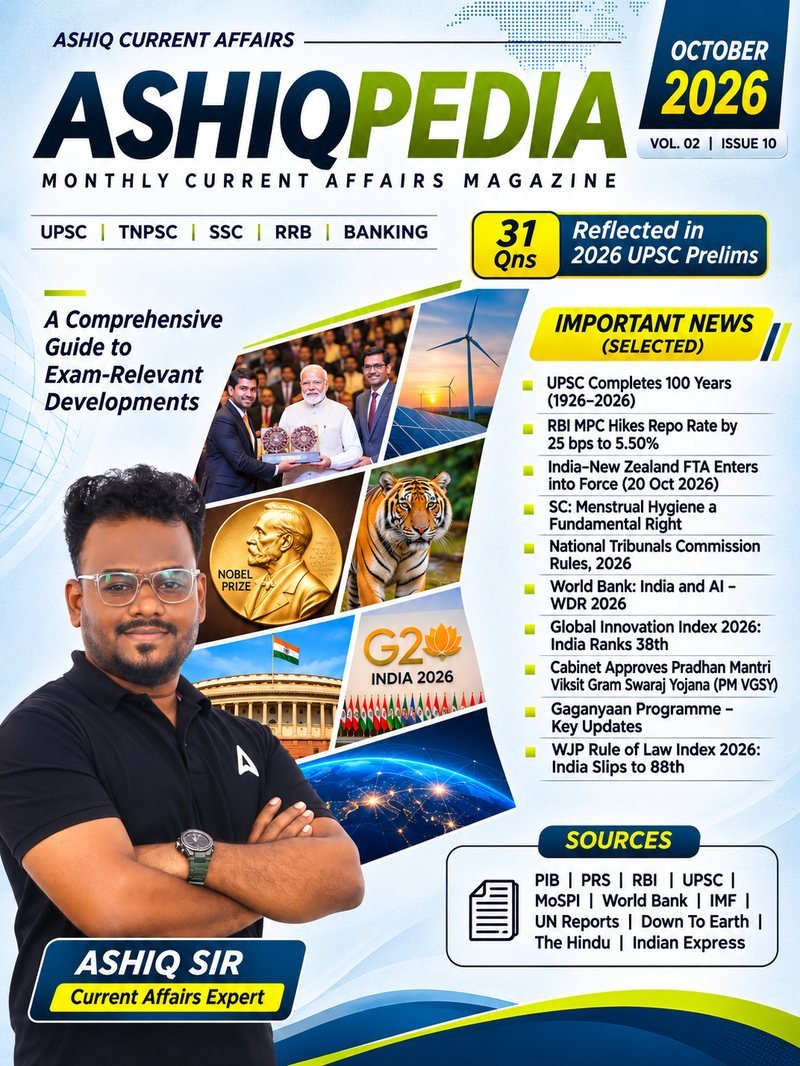
Monthly magazine: AshiqPedia October 2026 (free PDF)
Free daily PDFs: ashiqcurrentaffairs.com