
How to use this material
Exam Tags & Source: Syllabus mapping for UPSC / TNPSC / SSC-RRB + clickable source link
Why in News: The news in 2–3 lines – read this first
▸ Sub-headings: Simple explanation + all facts, figures, names and years
GS Facts: Static GK linked to the news (blue box)
⚠ Exam Trap: Common confusions examiners use in options (orange box)
✍ Mains Angle: Probable Mains question with value points (purple box)
★ Important One-liners: Short news under each theme + Rapid Revision table. Highlighted = must-remember
✎ Top 5 Quiz: Day’s 5 most important MCQs at the end, with answer key
ECONOMY
RBI MPC Hikes Repo Rate by 25 bps to 5.50%
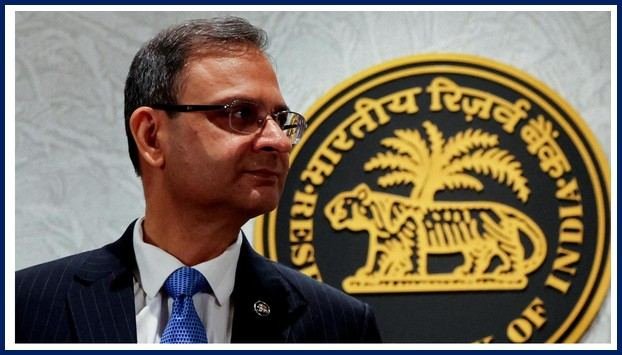
Why in News: The Monetary Policy Committee (MPC) of the Reserve Bank of India (RBI) on 7 October 2026 raised the policy repo rate by 25 basis points to 5.50% and changed its stance from ‘neutral’ to ‘calibrated tightening’
Policy Rates at a Glance
| Rate | Before | Now |
|---|---|---|
| Policy Repo Rate | 5.25% | 5.50% |
| Standing Deposit Facility (SDF) | 5.00% | 5.25% |
| Marginal Standing Facility (MSF) | 5.50% | 5.75% |
| Bank Rate | 5.50% | 5.75% |
- Stance: Neutral → Calibrated Tightening. Governor Sanjay Malhotra: future action can only be a rate hike or a pause – no cuts.
Rate Cycle – How We Got Here
- Long hold: Repo kept at 6.50% for 11 meetings (April 2023 – December 2024).
- Easing cycle: Cut by 125 bps in phases, from 6.50% to 5.25%; the last cut was in December 2025.
- Pause: Kept at 5.25% for the next four MPC meetings.
- Now: First hike of the new cycle – 5.50% (7 October 2026).
Why did the MPC Hike Rates?
- Global shock: Sudden re-escalation of the West Asia conflict in September → hardening and volatile crude oil prices.
- Inflation not benign: Headline CPI inflation expected to average almost 5.8% in the next three quarters.
- Inflation spreading (generalisation): Core inflation rose to 4.2% in August (after 3.9% for three months); food price rises are broad-based, with spikes in sugar and onion.
- Weather risk: Weak southwest monsoon and strong El Niño may hit the rabi season and rural demand.
- Goal: Prevent second-round effects – supply shocks turning into higher inflation expectations and firm-level price setting.
RBI Projections for 2026-27
| Indicator | FY27 | Q2 | Q3 | Q4 |
|---|---|---|---|---|
| Real GDP growth | 7.1% | 7.2% | 6.9% | 6.8% |
| CPI inflation | 5.2% | 4.9% | 6.0% | 5.7% |
- GDP: 7.1% – revised up by 40 bps; Q1 of 2027-28 projected at 7.1%.
- CPI: 5.2% (raised from 5.0%); Q1 of 2027-28 at 5.6%. Core inflation projected at 4.4%.
External Sector and Financial Stability
- Merchandise trade deficit: $58.7 billion in July–August 2026 (vs $55.1 billion a year ago) – due to electronics and crude oil imports.
- Net FDI: $13.8 billion (April–August 2026) vs $9.6 billion a year ago.
- FPI: Net outflows of $10.3 billion (April – 5 October 2026); Balance of Payments still expected to be in surplus.
- Forex reserves: Import cover of ~11 months; external debt cover 94.4%.
- Banks and NBFCs: Capital adequacy, liquidity, asset quality and profitability remain robust.
Understanding the Terms
- Repo rate: Rate at which RBI lends short-term money to banks. A hike makes loans costlier → reduces demand → controls inflation.
- Basis point (bps): 1 bps = 0.01%; so 25 bps = 0.25%.
- LAF corridor: SDF (floor) = Repo – 0.25%; MSF (ceiling) = Repo + 0.25%. The Bank Rate is aligned with the MSF.
- SDF: Introduced in April 2022 – banks park surplus money with RBI without collateral; replaced fixed-rate reverse repo as the floor.
- Core inflation: Inflation excluding food and fuel – shows how far price rise has spread in the economy.
GS Facts: Monetary Policy Committee
- Statutory body under Section 45ZB of the RBI Act, 1934 (amended in 2016)
- 6 members – 3 from RBI (Governor as Chair)
- 3 external members appointed by the Centre (4-year term)
- Meets at least 4 times a year; Governor has a casting vote
- Inflation target: 4% CPI with band of 2%–6% (Flexible Inflation Targeting)
- RBI Governor: Sanjay Malhotra (26th Governor).
⚠ Exam Trap: ‘Calibrated tightening’ is not new – the RBI used this stance in October 2018 too. Remember: SDF is the floor, MSF is the ceiling, and the Bank Rate = MSF rate. A hike in repo is contractionary monetary policy.
✍ Mains Angle (UPSC)
Q. ‘Monetary policy is a blunt tool against supply-side inflation.’ Evaluate in the context of the RBI’s October 2026 rate hike.
Value points: Second-round effects, inflation expectations, growth trade-off, role of fiscal and supply-side measures (buffer stocks, fuel taxes).
SCIENCE & TECH
World’s First Working Nuclear Clocks
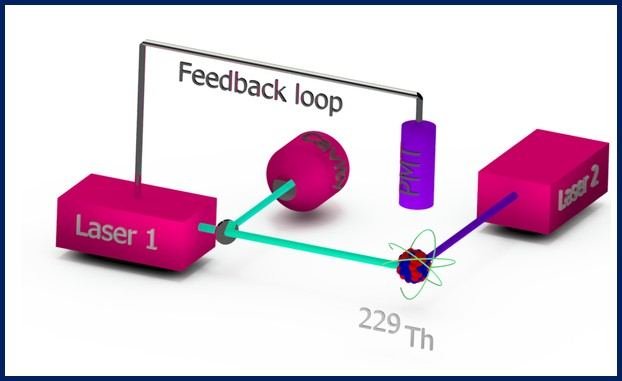
Why in News: In two papers in the journal Nature, scientists from Europe and China reported the world’s first working nuclear clocks, based on the nucleus of thorium-229
Atomic Clock vs Nuclear Clock
- Atomic clocks are the world’s gold standard of time – used in GPS navigation and synchronised networks. A ytterbium atomic clock misses one second every 23 billion years.
- Atomic clock: Uses the energy jumps of an atom’s electrons – but electrons are easily disturbed by electric/magnetic fields and temperature.
- Nuclear clock: Uses energy jumps inside the nucleus, which is shielded by the electron cloud – so it is less disturbed and potentially more precise.
Why Thorium-229?
- Exciting a nucleus normally needs X-rays or gamma rays, which are hard to control.
- The thorium-229 nucleus has an unusually low transition energy, which can be triggered by an ultraviolet (UV) laser.
How Does the Clock Tick?
- A laser’s electric field oscillates rapidly; the clock counts these cycles – like an old clock counts pendulum swings.
- Scientists shine the laser on thorium-229 nuclei and check how readily they get excited. If excitation drops, the laser has drifted, and a computer feedback loop corrects it.
The Two Studies
- China (Beijing and Shanghai teams): Embedded thorium-229 in calcium fluoride crystals; a feedback loop kept the UV laser locked to the nuclei → could lead to compact, portable clocks.
Austria and Germany: Built a thorium-229 clock and ran it alongside a ytterbium atomic clock to search for dark matter.
Thorium-229’s low energy arises because the strong nuclear force and electromagnetic force nearly cancel each other – making the clock very sensitive to tiny changes in fundamental constants.
Some theories say ultralight dark matter may make these constants fluctuate; no signal was found.
- Status: Prototypes are not yet as precise as the best atomic clocks, but the design is proven; better lasers and crystals are expected to help them surpass atomic clocks.
Applications
- Ultra-precise navigation and timing; testing fundamental physics; dark matter search; possible future redefinition of the second.
India Connect
- CSIR-National Physical Laboratory (NPL), New Delhi maintains Indian Standard Time using atomic clocks.
- NavIC satellites use rubidium atomic clocks; NVS-01 (2023) carried India’s first indigenous atomic clock.
- Thorium (atomic number 90) is the fuel of the third stage of India’s nuclear programme; India has large reserves in monazite sands (Kerala, Odisha, TN).
GS Facts: Defining Time
- The SI second is defined using the caesium-133 atom (9,192,631,770 oscillations)
- Optical clocks (ytterbium, strontium) are more precise than caesium clocks
- Dark matter makes up about 27% of the universe, dark energy about 68%, ordinary matter only about 5%.
⚠ Exam Trap: An atomic clock uses electron transitions; a nuclear clock uses nuclear transitions. Thorium-229 is excited by a UV laser, not X-rays. The SI second is still defined by caesium-133, not thorium or ytterbium.
Indian Scientists Develop Metal-free Catalyst for Zinc–Air Batteries
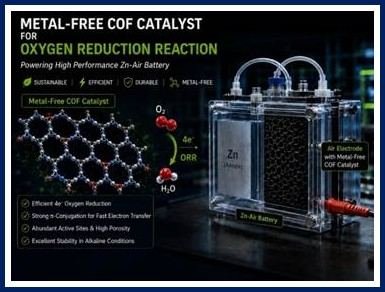
Why in News: Researchers from S.N. Bose National Centre for Basic Sciences (SNBNCBS), Kolkata, Institute of Nano Science and Technology (INST), Mohali (both under DST) and SRM University, Amaravati developed a metal-free porous organic material, TTT-DHTD, that performs almost as well as platinum as a catalyst in zinc–air batteries.
Key Findings
- Material: TTT-DHTD, a metal-free covalent organic framework (COF) made from two organic linkers – TTT and DHTD.
- Made of: Abundant elements – carbon, sulfur, nitrogen and hydrogen; forms an ultra-porous, honeycomb-like network.
- Performance: About 96% of commercial platinum catalysts.
- Stability: No degradation even after 120 hours of continuous operation.
- Published in: Science Advances.
- Team leads: Dr. Pradip Pachfule (SNBNCBS), Prof. Ramendra Sundar Dey (INST) and Prof. Ranjit Thapa (SRM University, Amaravati); computer simulations explained the ideal oxygen-binding sites.
Understanding the Science
- Oxygen Reduction Reaction (ORR): Reaction in which oxygen from the air takes electrons at the electrode – it decides how efficiently a Zn–air battery or fuel cell works.
- Problem: The best ORR catalyst, platinum, is rare and very expensive – a barrier to large-scale clean energy.
Zinc–Air Batteries
- Use abundant, cheap, safe zinc and draw oxygen directly from air – no need to store a cathode material.
- vs Lithium-ion: Higher theoretical energy density, lower cost, better safety and sustainability.
- vs Hydrogen fuel cells: Simpler and compact; no high-pressure hydrogen storage or hydrogen infrastructure needed.
- Challenges: Rechargeability, cycle life and slow ORR kinetics.
Significance
- Replacing platinum can make clean transport, portable power and renewable energy storage cheaper; shows India’s growing strength in sustainable materials research.
GS Facts: Framework Materials
- 2025 Nobel Prize in Chemistry – Susumu Kitagawa, Richard Robson, Omar Yaghi for Metal-Organic Frameworks (MOFs)
- COFs are similar porous frameworks made without metals
- SNBNCBS (est. 1986) is named after Satyendra Nath Bose (Bose–Einstein statistics; ‘boson’)
- INST Mohali is an autonomous DST institute.
⚠ Exam Trap: The new catalyst is a COF (metal-free), not a MOF. It replaces platinum (not lithium). In a Zn–air battery, the oxygen comes from the air, so no cathode material is stored.
DEFENCE
★ Important One-liners
- 94th INDIAN AIR FORCE DAY – 8 OCTOBER 2026: Theme: ‘Indian Air Force – Infallible, Impervious and Precise’
- Message by Chief of the Air Staff, Air Chief Marshal Amar Preet Singh on Akashvani
- Operation Sindoor (last year) reaffirmed the power of integrated air operations
- Milestones this year: Exercise Vayushakti, bilateral exercises, Dronathon and the ongoing multilateral air exercise Tarang Shakti
- IAF: founded 8 October 1932; motto ‘Nabha Sparsham Deeptam’ (from the Bhagavad Gita)
- Tarang Shakti – India’s largest multinational air exercise; first edition in 2024 (Phase-I at Sulur, Tamil Nadu)
- Air Marshal Ashutosh Dixit takes over as 29th CAS from 31 October 2026.
ENVIRONMENT
★ Important One-liners
- CHEETAHS RELEASED IN VEERANGANA DURGAVATI TIGER RESERVE (MP): MP Chief Minister Mohan Yadav released
two cheetahs – ‘Vyom’ and ‘Neera’ – in
Veerangana Durgavati Tiger Reserve (VDTR), Sagar district on 7 October 2026
- VDTR (in Bundelkhand) becomes the third cheetah habitat in MP after Kuno National Park (Sheopur) and Gandhi Sagar Wildlife Sanctuary (Mandsaur)
- Released on the concluding day of Wildlife Conservation Week (1–7 October)
- CM also released the ‘Vulture Population Estimation 2026’ report and a book on VDTR in Bundelkhandi
- About ₹80 crore collected from MP sanctuaries this year; ₹20 crore given to nearby villagers
- Homestays in the buffer zone with a grant of ₹2–3 lakh
- Two more cheetahs to be brought next month
- VDTR: notified in 2023 – MP’s 7th and India’s 54th tiger reserve; formed from Nauradehi and Durgavati Wildlife Sanctuaries.
INTERNATIONAL
Ghana Cabinet Approves Bid to Join BRICS; India ‘Supportive’, Says Jaishankar
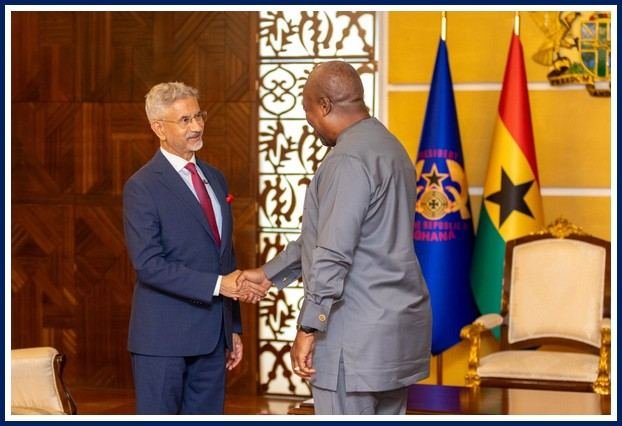
Why in News: Ghana’s Cabinet approved a decision to seek membership of BRICS, and the country will now formally apply, said Ghana’s Foreign Minister Samuel Okudzeto Ablakwa.
Why Ghana Wants to Join BRICS
- To diversify international partnerships and have more options for its development agenda – while not abandoning traditional partners like the IMF and World Bank.
- To support industrialisation, job creation and an agenda of ‘resource sovereignty’.
- Aligned with President John Dramani Mahama’s vision of a multipolar world.
- Next step: Formal application; admission needs the approval (collective consideration) of existing BRICS members.
India–Ghana Ties – Key Points
- Trade: More than doubled from around USD 3 billion (2024); Ghana aims for about USD 7 billion.
- New areas: Pharmaceuticals and healthcare, mining, defence, railways, digital – to take the Comprehensive Partnership to the ‘next level’.
- Agreements signed: On agricultural research and training and biodiversity.
- Indian investment: In pharma and medical services, poultry and renewable energy.
- Global South: Common view on UN reform, including the Security Council; both as voices of strategic autonomy.
ICAR – CSIR-CRI (Ghana) MoU
- Between: Indian Council of Agricultural Research (ICAR) and Ghana’s Crops Research Institute (CSIR-CRI); 5-year MoU.
- Phase 1: Vegetable crops, especially tomato – ICAR to introduce high-yielding tomato lines and varieties.
- Also: Processing and value addition of cassava, yam and other tubers; post-harvest management – cold storage, refrigerated transport, sorting, grading.
- Exchange of scientists, germplasm and breeding material; commercial partner: Arima Farms Ltd., Ghana; overseen by a Joint Working Group meeting in New Delhi and Accra.
About BRICS
- Origin: Term ‘BRIC’ coined in 2001; first summit at Yekaterinburg (Russia), 2009; South Africa joined in 2010.
- Expansion (2024): Egypt, Ethiopia, Iran, UAE; Indonesia joined in 2025. A ‘partner country’ category was created at the Kazan Summit (2024).
- New Development Bank (NDB): Agreed at Fortaleza (2014); HQ Shanghai.
- India holds the BRICS Chairship in 2026.
GS Facts: Ghana
- Capital: Accra
- Currency: Cedi
- Formerly the Gold Coast; first sub-Saharan African colony to gain independence (1957, Kwame Nkrumah)
- One of the world’s top cocoa producers
- Lake Volta – one of the largest man-made lakes
- The Prime Meridian (0°) passes through Ghana
- India–Ghana ties raised to Comprehensive Partnership during PM Modi’s visit (July 2025).
⚠ Exam Trap: Ghana has only approved a bid – it is not yet a BRICS member. Ethiopia (part of the EAM’s tour) is already a BRICS member (2024). Don’t confuse CSIR-CRI (Ghana) with India’s CSIR.
✍ Mains Angle (UPSC)
Q. BRICS expansion offers opportunities and challenges for India. Discuss.
Value points: Voice of Global South, India’s 2026 chairship, risk of anti-West tilt, consensus-based decision-making, Africa outreach.
TAMILNADU
★ Important One-liners
- THAIMAAMAN THANGA MOTHIRAM THITTAM – ELIGIBILITY RELAXED: Under the scheme, a one-gram gold ring is given to children born in government hospitals in Tamil Nadu
- Launched by Chief Minister C. Joseph Vijay on 28 September 2026; implemented retrospectively from 22 June 2026
- Change: Children of mothers born in TN who moved to another State after marriage are now eligible, if the mother’s parents are permanent residents of TN
- Triggered by the case of Uma Maheswari (living in Mysuru, Karnataka; parents in Karaikudi, Sivaganga) who delivered at Karaikudi Government Headquarters Hospital on 17 September
- Government Order by Health and Family Welfare Department; Principal Secretary Darez Ahamed
- Meaning: ‘Thaimaaman’ = maternal uncle – traditionally gifts a gold ring to the newborn
- Related scheme: Dr. Muthulakshmi Reddy Maternity Benefit Scheme gives financial aid to pregnant women.
AWARDS
Nobel Prize in Chemistry 2026: Henri B. Kagan and Kenso Soai for Mirror-Image Molecules
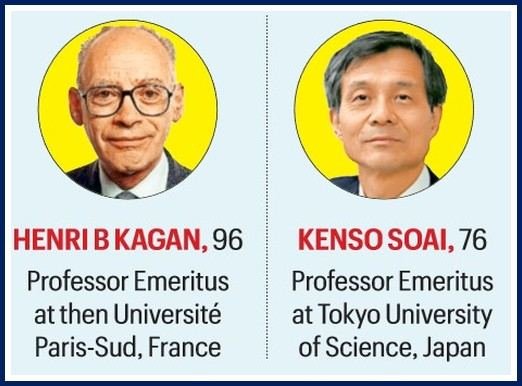
Why in News: The 2026 Nobel Prize in Chemistry has been awarded to Henri B. Kagan and Kenso Soai ‘for the discovery of non-linear effects and autocatalysis in asymmetric organic synthesis’ – showing how homochirality (life’s preference for one mirror-image form of molecules) can arise.
The Laureates
- Henri B. Kagan (96): Professor Emeritus at the then Université Paris-Sud, France.
- Kenso Soai (76): Professor Emeritus at Tokyo University of Science, Japan.
Key Concepts (Simple Explanation)
- Chirality: Some molecules exist in two forms that are non-superimposable mirror images – like our left and right hands. Same atoms, same order – only the 3D arrangement differs.
- Enantiomers: The two mirror-image forms of a chiral molecule.
- Homochirality: Life uses only one form – e.g., proteins use L-amino acids and DNA/RNA use D-sugars.
- Problem: Normal lab reactions produce both forms in nearly equal amounts (a racemic mixture).
What the Laureates Did
- Background: In the early 1900s, German chemist Willy Marckwald used a chiral catalyst to get a slightly uneven yield – but it could not be improved, and the reason was unknown.
- Kagan (1980s) – Non-linear effect: Earlier it was believed the product’s imbalance would mirror the catalyst’s imbalance (a linear relationship). Kagan showed that even a mildly chiral catalyst can give a much greater asymmetry, and explained why.
- Soai (1990s) – Asymmetric autocatalysis: Designed the first reaction where the product acts as its own catalyst and makes copies of itself – after about a decade of work, it yielded 99.5% of one enantiomer, similar to nature.
- Meaning: Homochirality is not exclusive to living things – it can be produced in a lab. This opens new paths to study the origin of life’s chemistry.
Why it Matters – The Thalidomide Lesson
- Thalidomide: Introduced in the late 1950s by a West German company as a sedative; given to pregnant women for morning sickness.
- By 1961, linked to severe birth defects in thousands of babies across 46 countries – many with phocomelia (shortened or absent limbs).
- Reason: One enantiomer caused birth defects while the other gave the desired effect; the two forms can interconvert in the body.
- Today: Asymmetric synthesis helps make single-enantiomer drugs, flavours, fragrances and pesticides – cheaper and safer than separating mixed forms.
Related Nobel Prizes
- 2001 Chemistry: Knowles, Noyori and Sharpless – chirally catalysed reactions.
- 2021 Chemistry: Benjamin List and David MacMillan – asymmetric organocatalysis.
- 2026 so far: Medicine – Hegemann, Nagel, Deisseroth (optogenetics); Physics – Francis Halzen (IceCube neutrinos).
GS Facts: Nobel Prize in Chemistry
- Awarded by the Royal Swedish Academy of Sciences
- First awarded in 1901 to Jacobus van ‘t Hoff
- 2025: Kitagawa, Robson, Yaghi – Metal-Organic Frameworks
- Indian-origin laureate: Venkatraman Ramakrishnan (2009) – structure of the ribosome.
⚠ Exam Trap: Kagan = non-linear effect; Soai = autocatalysis – don’t swap them. Thalidomide harm was due to its mirror-image form (enantiomer), not an impurity. Proteins use L-amino acids, not D.
SPORTS
★ Important One-liners
- PRAMOD BHAGAT & BHAVINA PATEL – FLAG BEARERS FOR ASIAN PARA GAMES 2026: Paralympic medallists Pramod Bhagat (para badminton) and Bhavina Patel (para table tennis) will lead India at the opening ceremony on 18 October 2026 in Nagoya, Japan
- Pramod: 6 Asian Para Games medals (2014–2023) – 2 gold, 4 bronze; Tokyo 2020 Paralympic gold
- Bhavina: 2 medals (2018–2023) – 1 silver, 1 bronze; Tokyo 2020 Paralympic silver
- Together: 8 Asian Para Games medals
- 5th Asian Para Games: 18–24 October 2026, Aichi–Nagoya (first time Japan hosts)
- India’s best: Hangzhou 2022 – 111 medals (29 gold).
RAPID REVISION
| Topic | Key Fact to Remember |
|---|---|
| Repo rate | Raised 25 bps to 5.50% (7 Oct 2026) |
| MPC stance | Neutral → Calibrated Tightening |
| SDF / MSF / Bank Rate | 5.25% / 5.75% / 5.75% |
| RBI FY27 projections | GDP 7.1%; CPI inflation 5.2% |
| Nuclear clock | Thorium-229; excited by UV laser |
| TTT-DHTD | Metal-free COF; ~96% of platinum’s performance |
| 94th Air Force Day | Theme: Infallible, Impervious and Precise |
| VDTR cheetahs | Vyom & Neera; Sagar district, MP |
| Ghana | Cabinet approved bid to join BRICS |
| ICAR–CSIR-CRI MoU | 5 years; tomato, cassava, yam |
| BRICS Chair 2026 | India |
| Thaimaaman Thanga Mothiram | 1-gram gold ring; TN govt hospitals |
| Nobel Chemistry 2026 | Henri B. Kagan & Kenso Soai – asymmetric synthesis |
| Para Games flag bearers | Pramod Bhagat & Bhavina Patel |
TOP 5 QUIZ OF THE DAY
Q1. Consider the following statements regarding the RBI’s monetary policy of October 2026:
1. The policy repo rate was raised to 5.50%.
2. The Standing Deposit Facility rate now acts as the ceiling of the LAF corridor.
3. The Bank Rate has been aligned with the MSF rate at 5.75%.
Which of the statements given above is/are correct?
- (a) 1 only
- (b) 1 and 3 only
- (c) 2 and 3 only
- (d) 1, 2 and 3
Q2. With reference to zinc–air batteries, consider the following statements:
1. They draw oxygen directly from the air for the electrode reaction.
2. They have a lower theoretical energy density than lithium-ion batteries.
3. Their performance depends on the efficiency of the oxygen reduction reaction.
Which of the statements given above is/are correct?
- (a) 1 and 2 only
- (b) 1 and 3 only
- (c) 2 and 3 only
- (d) 1, 2 and 3
Q3. Which of the following sites in Madhya Pradesh have received cheetahs under Project Cheetah?
1. Kuno National Park
2. Gandhi Sagar Wildlife Sanctuary
3. Veerangana Durgavati Tiger Reserve
4. Panna Tiger Reserve
Select the correct answer using the code given below:
- (a) 1 and 2 only
- (b) 1, 2 and 3 only
- (c) 2, 3 and 4 only
- (d) 1, 2, 3 and 4
Q4. Which of the following countries are members of BRICS?
1. Ethiopia
2. Indonesia
3. Ghana
4. Egypt
Select the correct answer using the code given below:
- (a) 1, 2 and 4 only
- (b) 1, 3 and 4 only
- (c) 2 and 3 only
- (d) 1, 2, 3 and 4
Q5. Consider the following statements:
1. Enantiomers are made of different sets of atoms connected in a different order.
2. Proteins in living organisms are made almost entirely of L-amino acids.
3. In an autocatalytic reaction, the product itself acts as a catalyst.
Which of the statements given above is/are correct?
- (a) 1 and 2 only
- (b) 2 and 3 only
- (c) 1 and 3 only
- (d) 1, 2 and 3
ANSWER KEY & EXPLANATIONS
Q1 – (b): The SDF is the floor (5.25%) of the LAF corridor; the MSF (5.75%) is the ceiling, and the Bank Rate is aligned with the MSF.
Q2 – (b): Zn–air batteries have a higher theoretical energy density than Li-ion batteries.
Q3 – (b): Q1 – (b): VDTR (Sagar district) is the third cheetah site after Kuno and Gandhi Sagar; Panna has not received cheetahs.
Q4 – (a): Q1 – (a): Ghana has only decided to apply; Ethiopia and Egypt joined in 2024, Indonesia in 2025.
Q5 – (b): Enantiomers have the same atoms in the same order; they differ only in 3D arrangement.
— Keep Reading, Keep Revising —
Free daily PDFs: ashiqcurrentaffairs.com