
How to use this material
Exam Tags & Source: Syllabus mapping for UPSC / TNPSC / SSC-RRB + clickable source link
Why in News: The news in 2–3 lines – read this first
▸ Sub-headings: Simple explanation + all facts, figures, names and years
GS Facts: Static GK linked to the news (blue box)
⚠ Exam Trap: Common confusions examiners use in options (orange box)
✍ Mains Angle: Probable Mains question with value points (purple box)
★ Important One-liners: Short news under each theme + Rapid Revision table. Highlighted = must-remember
✎ Top 5 Quiz: Day’s 5 most important MCQs at the end, with answer key
Here are the daily current affairs for 23 October 2026 in English – ISRO’s NVS-03 launch to bolster NavIC, Odisha’s Agri-PV Policy 2026 (India’s first dedicated agrivoltaics policy), the new PM Divyangjan Pension Yojana (40% benchmark disability), PM-DAKSH results and its merger with PMKVY, the Loss and Damage Fund’s first allocation to Nepal, the butterfly migration from the Eastern to the Western Ghats, the first human case of Shamonda virus, Polish PM Donald Tusk’s visit to India, the 12th BRICS Parliamentary Forum, Kashi Tamil Sangamam 5.0 and the green terminal at VOC Port – with GS Facts, Exam Traps, Mains Angles, a Rapid Revision table and a Top 5 Quiz.
POLITY
★ Important One-liners
- 12th BRICS PARLIAMENTARY FORUM IN NEW DELHI: The Parliament of India will host the 12th BRICS Parliamentary Forum on 26–27 October 2026 in the Central Hall of Samvidhan Sadan
- Theme: “Strengthening Parliaments for People-Centric Development”
- Announced by Lok Sabha Speaker Om Birla – ‘a new chapter in India’s parliamentary diplomacy’
- Brings together Presiding Officers and parliamentary leaders from BRICS member and partner countries, Union Ministers, Rajya Sabha Deputy Chairman Harivansh and Presiding Officers of State Legislatures
- Held under India’s BRICS Chairship (2026).
AGRICULTURE
Odisha to Unveil India’s First Dedicated Agrivoltaics (Agri-PV) Policy
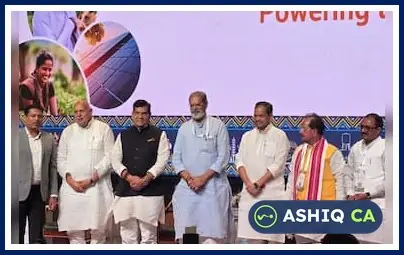
Why in News: Odisha will soon unveil its Agri-PV Policy 2026 – making it the first State in India with a separate policy for agrivoltaics (growing crops and generating solar power on the same land). It was announced by Deputy Chief Minister Kanak Vardhan Singh Deo at the 7th Agrivoltaics World Conference 2026, Bharat Mandapam, New Delhi.
Key Features of the Proposed Policy
- Target: 1 GW of agrivoltaic capacity by 2030.
- Farmers first: At least 90% of project land must remain under active cultivation.
- Principle: ‘One Field, Two Harvests’ – crops below, electricity from panels above.
- Land protection: Land keeps its agricultural classification; farmers stay eligible for crop insurance.
- Two participation models: Farmers can invest in and own the systems (income from crops + power), or lease land to solar developers for assured long-term rent.
- For investors: 25-year Power Purchase Agreements (PPAs) with GRIDCO, guaranteed power offtake, grid connectivity and open-access rights.
- Linkages: With drip irrigation, solar pumps, cold storage and agro-processing.
Progress and Potential
- A 1 MW agrivoltaic project is under implementation; pilot collaboration with Nanyang Technological University (Singapore).
- Land: About 4.07 million acres of cropland suitable for agrivoltaics, plus about 4.77 million acres of fallow land.
- Earlier investment: ₹67,000 crore clean-energy commitments (6.8 GW) at the February 2026 renewable energy investor conclave.
Why Agrivoltaics?
- Climate adaptation: Raised panels create partial shade – less heat stress, more soil moisture, protection from excess sunlight; also shade for farm workers.
- Turns ‘Annadata’ (food provider) into ‘Urjadata’ (energy provider); avoids diverting farmland to solar parks.
GS Facts: Solar Energy Schemes
- PM-KUSUM (2019) – solar pumps and small solar plants on farmland
- PM Surya Ghar Muft Bijli Yojana (2024) – rooftop solar for households
- India’s target: 500 GW non-fossil capacity by 2030
- GRIDCO – Odisha’s State power trading utility.
⚠ Exam Trap:
- Odisha’s Agri-PV policy is the first dedicated State policy – not a Central scheme.
- At least 90% of land must stay under cultivation (not 90% under solar panels).
- Target is 1 GW by 2030.
SCHEMES
PM Divyangjan Pension Yojana: Disability Pension Aligned with RPwD Act (Explainer)
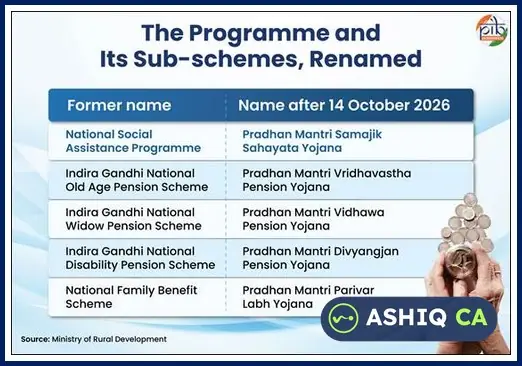
Why in News: Following the Cabinet decision of 14 October 2026 to continue the National Social Assistance Programme (NSAP) as the Pradhan Mantri Samajik Sahayata Yojana (₹53,428 crore, 2026-31), the Government explained the biggest change – the disability pension, now the Pradhan Mantri Divyangjan Pension Yojana, which is aligned with the RPwD Act, 2016.
Old vs New Disability Pension
| Feature | Earlier (IGNDPS) | Now (PM Divyangjan Pension) |
|---|---|---|
| Disability needed | 80% (severe) | 40% (benchmark) |
| Minimum age | 18 years | From birth |
| Central assistance (0–79 yrs) | ₹300/month | ₹375/month |
| Central assistance (80+ yrs) | ₹500/month | ₹625/month |
| Beneficiaries | 8.33 lakh | 27.48 lakh |
Why the Change?
- The disability pension began in February 2009 (as IGNDPS) using the 80% ‘severe disability’ test from Section 2(o) of the National Trust Act, 1999.
- The RPwD Act, 2016 (to implement the UN Convention on the Rights of Persons with Disabilities) defines benchmark disability as not less than 40% [Section 2(r)]; it came into force on 19 April 2017.
- The 40% benchmark already governs higher education, government jobs, land and housing – now the oldest social assistance programme is aligned too.
Who Benefits?
- Persons certified with 40–79% disability in BPL households (newly eligible).
- Children from birth with benchmark disability – earlier families had to wait till age 18.
- Existing pensioners – get the higher ₹375 / ₹625 rates.
- Unchanged conditions: Disability certificate required; household must be BPL; apply through the State welfare department.
About NSAP – Key Numbers
- Launched 15 August 1995 under Article 41; 100% central assistance; covers rural and urban BPL households.
- Four components: old age, widow and disability pensions (monthly) + a one-time family benefit on death of the primary breadwinner.
- State top-ups: ₹50 to ₹5,700 per month; average pension about ₹1,100 in most States/UTs.
- 2025-26 allocation: ₹9,652 crore (disability pension ₹290 crore); beneficiaries 3.09 crore → now 3.20 crore in all 36 States/UTs.
- Revised guidelines to be issued within three months.
GS Facts: Disability in India
- Census 2011: 2.68 crore persons with disabilities (2.21% of population)
- RPwD Act, 2016 lists 21 types of disabilities
- UNCRPD adopted in 2006; India ratified it in 2007
- Department of Empowerment of Persons with Disabilities under the Ministry of Social Justice and Empowerment.
⚠ Exam Trap:
- Old 80% criterion came from the National Trust Act, 1999; new 40% from the RPwD Act, 2016.
- Beneficiaries under the disability pension rise from 8.33 lakh to 27.48 lakh – total NSAP beneficiaries are 3.20 crore.
- Old age and widow pensions are unchanged.
PM-DAKSH Trained 1.87 lakh, Placed Over 96,000; Merged with PMKVY
Why in News: The Department of Social Justice and Empowerment said 1,87,305 candidates were trained and 96,162 placed under the PM-DAKSH scheme between 2020-21 and 2023-24. From 2024-25, the scheme has been subsumed into the Pradhan Mantri Kaushal Vikas Yojana (PMKVY) to avoid duplication.
About PM-DAKSH
- Full form: Pradhan Mantri Dakshta Aur Kushalta Sampann Hitgrahi Yojana – a Central Sector Scheme launched in 2020-21.
- Ministry: Social Justice and Empowerment.
- Target groups: SCs, OBCs, EWS/EBC, De-notified Tribes (DNTs) and safai karamcharis (incl. waste pickers), aged 18–45 years.
- Income limit: None for SCs, DNTs and safai karamcharis; below ₹3 lakh/year for OBC and EWS/EBC.
- Implemented through: NSFDC (SCs), NBCFDC (OBCs) and NSKFDC (safai karamcharis) – also gave loans for self-employment.
- PM-DAKSH-DEPwD: A special module for persons with disabilities.
Performance Rules
- Institutes had to ensure wage or self-employment for at least 70% of trainees – else they lost the third instalment (30%) of training cost.
- Funds: Expenditure ₹309.5 crore against ₹276.47 crore allotted (2020-21 to 2023-24).
- Evaluation: 90%+ beneficiaries said training matched career goals and local job needs; gains in confidence and social recognition, especially for women.
Why Merged?
- Its job roles were already covered under PMKVY – merging avoids duplication and uses one national skilling platform.
GS Facts: Skilling
- PMKVY – launched in 2015; under the Ministry of Skill Development and Entrepreneurship (MSDE); now in its 4.0 phase
- Skill India Mission – 15 July 2015 (World Youth Skills Day: 15 July)
- NSDC – National Skill Development Corporation (PPP, 2008).
⚠ Exam Trap:
- PM-DAKSH is under the Ministry of Social Justice and Empowerment, while PMKVY is under MSDE.
- Placement was 96,162 of 1,87,305 (about half).
- The 70% placement rule applied to training institutes.
SCIENCE & TECH
★ Important One-liners
- IITM PRAVARTAK SIGNS MoU WITH SRI LANKA’S DIALOG AXIATA: IITM Pravartak – a Technology Innovation Hub at IIT Madras funded by the Department of Science and Technology – signed an MoU with Sri Lankan telecom major Dialog Axiata PLC to support Sri Lanka’s research and innovation ecosystem
- Will connect universities and startups with technology expertise, business support and market access in Sri Lanka and beyond
- Signed by Dr. M.J. Shankar Raman (CEO, IITM Pravartak) and Supun Weerasinghe (Group CEO, Dialog Axiata), in the presence of Indian High Commissioner Santosh Jha
- Technology Innovation Hubs were set up under DST’s National Mission on Interdisciplinary Cyber-Physical Systems (NM-ICPS).
SPACE
ISRO to Launch NVS-03 on 30 October to Bolster NavIC
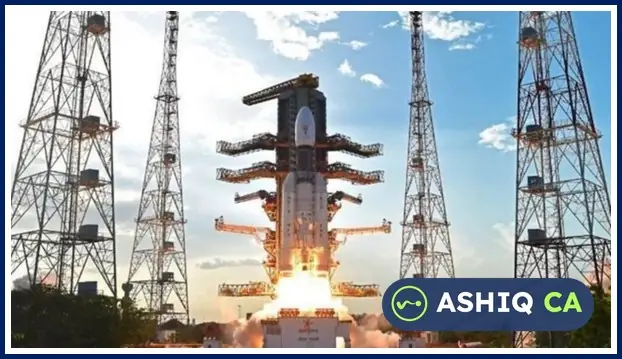
Why in News: ISRO will launch the navigation satellite NVS-03 on the GSLV Mk II from Satish Dhawan Space Centre, Sriharikota on 30 October 2026, to strengthen India’s own satellite navigation system NavIC, which is now working at a sub-optimal level.
Why NVS-03 is Urgent
- At least 4 fully functional satellites are needed for position and navigation services (1 is enough for timing).
- IRNSS-1F stopped providing navigation after its imported atomic clock failed on 13 March 2026 (it still offers one-way messaging).
- Now only IRNSS-1B, IRNSS-1L and IRNSS-1J (NVS-01) provide full positioning, navigation and timing (PNT) services.
- Of 11 navigation satellites launched since July 2013 (project cost about ₹2,250 crore), 6 failed – mostly due to defective imported atomic clocks, and some orbital issues (e.g., NVS-02/IRNSS-1K engine problem).
ISRO’s 2026 Launch Record
- PSLV failures in May 2025 and January 2026 led ISRO to a cautious approach for all launches.
- EOS-05 (launched 4 September 2026 on GSLV Mk II) – India’s first geosynchronous Earth observation satellite – the year’s only successful mission so far.
- GSLV Mk II (with indigenous cryogenic engine) has had six successive successful flights since 2021.
- Gaganyaan: First uncrewed test flight likely in late 2026 or early 2027.
About NavIC (Simple Explanation)
- Navigation with Indian Constellation – India’s own GPS-like system; work began in 1999 after the Kargil war, when Indian forces could not rely on the US-owned GPS.
- Accurate atomic clocks are its heart – position is calculated from signal travel time from satellites.
- Uses: military, disaster management, fishing, and tracking of trains – target of 12,000 trains (about 8,700 already equipped).
Coming Up
- ESTIC (Emerging Science, Technology and Innovation Conclave) from 27 October in New Delhi – ISRO to show models of the Bharatiya Antariksh Station and the New Generation Launch Vehicle; goal of an Indian human Moon landing by 2040.
GS Facts: NavIC
- Earlier called IRNSS (Indian Regional Navigation Satellite System)
- Covers India and about 1,500 km around it
- Uses L5 and S bands (L1 being added in NVS series)
- NVS-01 (2023) carried India’s first indigenous rubidium atomic clock
- ISRO Chairman: Dr. V. Narayanan.
⚠ Exam Trap:
- NVS-03 will fly on the GSLV Mk II, not PSLV or LVM3.
- NavIC is a regional system (India + ~1,500 km), not global like GPS.
- EOS-05 is India’s first geosynchronous Earth observation satellite.
ENVIRONMENT
UN Loss and Damage Fund Earmarks $21.6 million for Nepal’s Flood Recovery
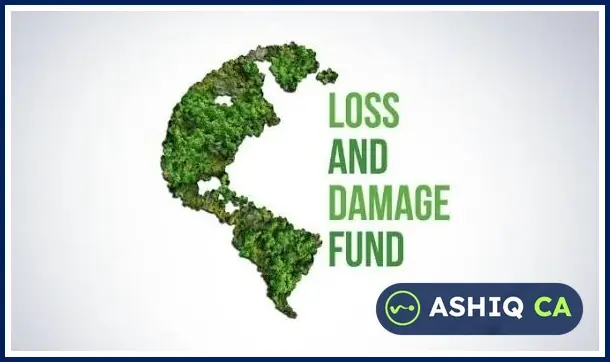
Why in News: The UN climate convention’s Fund for responding to Loss and Damage (FRLD) has set aside $21.6 million for Nepal to address damage from the Bhotekoshi floods (a glacial lake outburst flood – GLOF) of August 2026 – a landmark operational step for the Fund.
Key Details
- Allocation: $21.6 million (provisional), including $1.6 million ‘oversight fees’ paid to implementing organisations (multilateral banks, national institutions, UN agencies) – about $20 million for reconstruction.
- Pledges: More than $820 million (mostly by developed countries), of which $342 million for the start-up phase.
- Demand: 176 requests from 119 countries, worth about $2.8 billion – far more than available funds.
- Criticism (Ajay Mathur): The amount is less than 0.5% of Nepal’s estimated $5 billion reconstruction cost; release depends on further project proposals – risk of delay.
What is Loss and Damage? (Simple Explanation)
- Climate impacts that cannot be avoided by mitigation (cutting emissions) or adaptation (building resilience).
- Economic losses: damage to infrastructure, property, crops, livelihoods. Non-economic losses: loss of cultural heritage, biodiversity, displacement and trauma.
- Based on climate justice and CBDR-RC (Common But Differentiated Responsibilities and Respective Capabilities).
Timeline
- COP19, Warsaw (2013): Warsaw International Mechanism (WIM) – first formal UNFCCC framework, but no fund.
- COP27, Sharm el-Sheikh (2022): Countries agreed to set up a dedicated fund; a Transitional Committee designed it.
- COP28, Dubai (2023): Fund operationalised on day one of the summit.
GS Facts: Climate Funds
- Green Climate Fund (2010, HQ Incheon, South Korea) – mitigation & adaptation
- Adaptation Fund (Kyoto Protocol)
- FRLD – World Bank is its interim trustee; its Board is hosted by the Philippines
- GLOF – sudden flood when a glacial lake’s moraine dam bursts (e.g., South Lhonak, Sikkim, 2023).
⚠ Exam Trap:
- The Fund was agreed at COP27 (2022) but operationalised at COP28 (2023).
- The Warsaw International Mechanism (2013) had no fund.
- Nepal’s allocation includes $1.6 million oversight fees – actual reconstruction money is about $20 million.
Lakhs of Butterflies Migrate from Eastern to Western Ghats
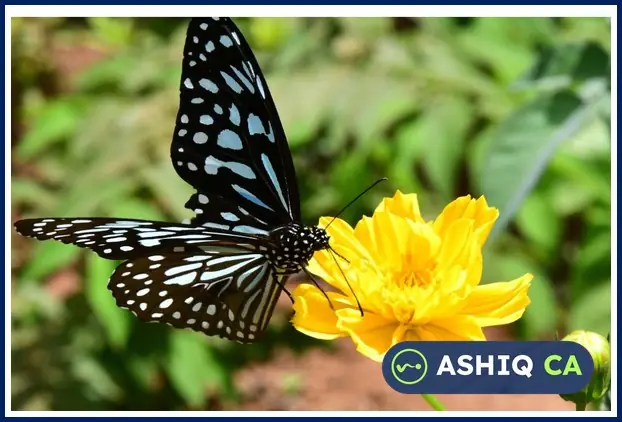
Why in News: With the onset of the North-East monsoon, lakhs of butterflies – mainly blue tigers, dark blue tigers and crows – are migrating from the Eastern Ghats to the Western Ghats, crossing Tamil Nadu cities like Salem, Erode, Tiruppur, Coimbatore and Madurai.
Key Observations
- Species: Blue tiger, dark blue tiger, common crow, double-banded crow and some emigrants.
- Numbers: 100–120 butterflies per minute at places in Coimbatore (e.g., Kalapatty main road, 18 October).
- Why: To escape heavy NE monsoon rains and reach host plants in Western Ghats forests.
The Migration Cycle
- Start after pre-monsoon showers in the Eastern Ghats → fly over TN plains and the Mysore plateau → reach forests, feed, mate, lay eggs and die.
- Jan–Feb: Millions congregate on trees in forests (e.g., Parambikulam, Silent Valley), waiting for environmental cues.
- Around May (before the SW monsoon), a later generation (third or fourth) flies back to the Eastern Ghats – a multi-generational migration.
- They fly when skies are clear, rest on trees by about 3 pm, and continue the next morning.
Citizen Science
- The Nature and Butterfly Society (TNBS) (started 2013) records counts; it has a checklist of 329 butterfly species in Tamil Nadu and gave baseline data for Sathyamangalam Tiger Reserve.
- Butterflies are bio-indicators of a healthy ecosystem and a food source for birds and spiders.
GS Facts: Butterflies
- State butterfly of Tamil Nadu: Tamil Yeoman (Cirrochroa thais), declared in 2019
- Tigers and crows belong to the milkweed butterfly group – toxic to predators
- Famous long-distance migrant: the Monarch butterfly of North America
- North-East monsoon gives Tamil Nadu most of its rainfall (October–December).
⚠ Exam Trap:
- The migration is from the Eastern Ghats to the Western Ghats in October (NE monsoon) and back around May – by a later generation, not the same butterflies.
- Tamil Yeoman is TN’s state butterfly; blue tiger is not.
✍ Mains Angle (UPSC)
Q. ‘Climate finance for loss and damage remains more symbolic than substantive.’ Examine with reference to the first allocation to Nepal.
Value points: Gap between pledges and needs, slow disbursement, CBDR and climate justice, Himalayan GLOF risks, India’s interests as a vulnerable developing country.
HEALTH
First Human Case of Shamonda Virus Reported in France
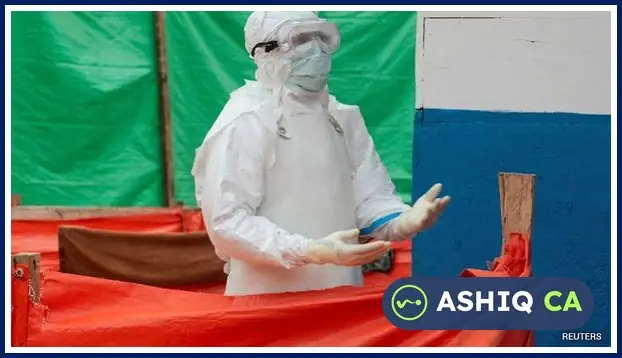
Why in News: The WHO reported the first documented human infection with Shamonda virus in France – an immunocompromised patient in Lyon who died. The virus was earlier known only in animals.
About Shamonda Virus
- An insect-borne Orthobunyavirus, first detected in cattle in Nigeria (1965); later found in parts of Africa and Asia.
- Spread: Through bites of infected Culicoides midges (tiny fly-like insects).
- Hosts: Mainly cattle; also sheep, goats, horses and alpacas.
- In animals: Fever, diarrhoea, reduced milk production; serious cases – abortions, severe foetal malformations, neurological disorders in some horses.
- Related virus: Schmallenberg virus (same group) – causes reproductive disorders in livestock.
Spread in Europe (2026)
- First identified in Europe in late July 2026; by 20 October, cases in more than 12 European countries, including France, Germany, Spain, Ireland, Italy and the Netherlands.
Risk to Humans
- The French patient had a severely weakened immune system and developed brain complications; a midge bite in eastern France is suspected.
- WHO: An isolated case, unlikely to spread widely at this time; no general public-health risk identified.
- Status: Not listed by WOAH or under EU animal health law – so reporting and surveillance are not mandatory (which does not mean it is harmless).
Key Concept – One Health
- Human, animal and environmental health are linked – most new infectious diseases are zoonotic (spread from animals to humans).
GS Facts: Health Bodies
- WHO – est. 1948, HQ Geneva; DG Tedros Adhanom Ghebreyesus
- WOAH (World Organisation for Animal Health; earlier OIE) – est. 1924, HQ Paris
- ECDC – European Centre for Disease Prevention and Control, Stockholm
- Other midge/mosquito-borne livestock viruses: Bluetongue.
⚠ Exam Trap:
- Shamonda spreads through midges (Culicoides), not mosquitoes or ticks.
- It was first found in Nigeria (1965), not Europe.
- WHO calls the human case isolated – it is not declared a public health emergency.
INFRASTRUCTURE
★ Important One-liners
- 19th URBAN MOBILITY INDIA CONFERENCE & 2nd NATIONAL URBAN CONCLAVE – BHUBANESWAR: The Ministry of Housing and Urban Affairs (MoHUA), with the Government of Odisha, is organising the 19th Urban Mobility India (UMI) Conference and Exhibition 2026 (23–24 October) and the 2nd National Urban Conclave (24–25 October) in Bhubaneswar
- UMI 2026 theme: “Urban Accessibility and Liveability in Digital Age”
- National Urban Conclave theme: ‘Urban Rising – Rethinking Urban Systems, Solutions and Delivery’; first edition held in New Delhi, November 2025
- UMI conferences follow the National Urban Transport Policy (2006).
INTERNATIONAL
Polish PM Donald Tusk’s Official Visit to India (21–23 October 2026)
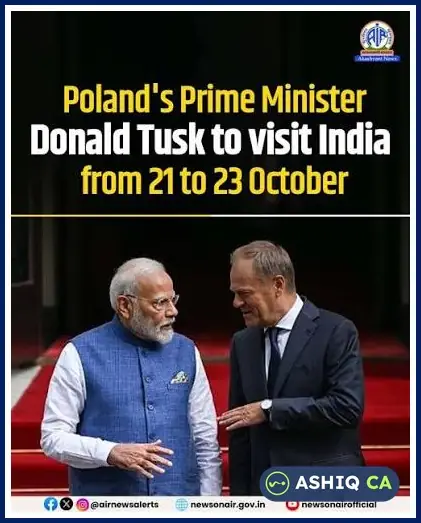
Why in News: Prime Minister of Poland Donald Tusk paid an official visit to India from 21 to 23 October 2026, with about 100 CEOs. The leaders set a target of doubling bilateral trade by 2030 and gave fresh momentum to the India–Poland Strategic Partnership.
Key Announcements
| Announcement | Area |
|---|---|
| Doubling bilateral trade by 2030 | Trade |
| Poland joins the Coalition for Disaster Resilient Infrastructure (CDRI) | Disaster Management |
| Establishment of a Defence Industry Dialogue | Defence |
| Dialogue on counter-terrorism | Counter-terrorism |
Background
- PM Modi’s visit to Poland (August 2024) raised ties to a Strategic Partnership; Action Plan 2024–2028 adopted (mid-term review in Warsaw, September 2026).
- Leaders welcomed the India–EU Summit (27 January 2026), the India–EU FTA (called for early signing and ratification) and the India–EU Security and Defence Partnership (January 2026).
Areas of Cooperation
- Economy: India congratulated Poland on crossing a $1 trillion GDP; Poland as a gateway to Central and Eastern Europe; sectors – machinery, defence, infrastructure, pharma, critical minerals, energy, ICT; joint research on AI, semiconductors, quantum.
- Defence: 8th Joint Working Group on Defence (Warsaw, Sept 2026); agreement on classified information expected soon.
- Critical minerals: Recycling of batteries, refining of rare earths; an MoU on geology and mining under negotiation.
- Connectivity: More direct flights, ports and shipping, IMEC (India–Middle East–Europe Economic Corridor); cooperation in polar research.
- Global issues: Poland supports India’s permanent UNSC seat and its candidature for a non-permanent seat (2028–29); both condemned the Pahalgam attack (22 April 2025) and called for the CCIT.
- Invitations: India invited Poland to join the International Solar Alliance, Global Biofuels Alliance and Indo-Pacific Oceans Initiative (IPOI); welcomed the first India–Visegrad Group (V4) Foreign Ministers’ meeting.
Historical Bond – ‘The Good Maharaja’
- During World War II, India sheltered thousands of Polish women and children – at Balachadi by Jam Saheb Digvijaysinhji of Nawanagar (honoured in Warsaw as the ‘Good Maharaja’) and at Valivade (Kolhapur).
- Jam Saheb Memorial Youth Exchange Programme – second edition in October 2026.
- Poland helped evacuate 2,000+ Indian students from Ukraine under Operation Ganga (2022).
GS Facts: Poland & Groupings
- Poland: capital Warsaw; currency Złoty; joined NATO (1999) and the EU (2004)
- Visegrad Group (V4): Poland, Hungary, Czech Republic, Slovakia (formed 1991)
- CDRI: launched by India in 2019; HQ New Delhi
- Kraków’s Jagiellonian University has an ICCR Chair of Indian Studies.
⚠ Exam Trap:
- The Strategic Partnership dates to August 2024 (Modi’s visit), not this visit.
- Poland joined CDRI; it was only invited to the ISA, GBA and IPOI.
- V4 = Poland, Hungary, Czech Republic, Slovakia – not Austria.
✍ Mains Angle (UPSC)
Q. ‘Central Europe is becoming an important pillar of India’s Europe policy.’ Discuss with reference to India–Poland ties.
Value points: Strategic Partnership 2024, India–EU FTA, defence-industrial cooperation, Poland as gateway to CEE, historical goodwill, Russia–Ukraine war differences.
ART & CULTURE
★ Important One-liners
- KASHI TAMIL SANGAMAM 5.0 – REGISTRATION OPENS: Union Minister Pralhad Joshi launched the registration portal for the fifth edition of Kashi Tamil Sangamam (KTS 5.0), to be held from 28 November to 12 December 2026
- Theme: “Thirukkural Payilvom – Thirukkural Abhyas Karen” (Let us learn Thirukkural)
- Celebrates the ancient bonds between Tamil Nadu and Kashi – two seats of learning – under Ek Bharat Shreshtha Bharat
- First held in 2022
- Organised by the Department of Higher Education (Ministry of Education) with IIT Madras, BHU, Central Institute of Classical Tamil (CICT), Chennai, the UP Government and several Union Ministries
- Thirukkural – classic Tamil text of 1,330 couplets by Thiruvalluvar.
- ₹200 COMMEMORATIVE COIN FOR MATA SAHIB HASI DEVI JI: President Droupadi Murmu released a commemorative ₹200 coin marking the 200th birth anniversary of Pujya Mata Sahib Hasi Devi Ji at Lok Bhawan, Raipur (Chhattisgarh)
- She was the fifth head (Peethadheesh) of the historic Shadani Darbar, a spiritual and cultural centre of the Sindhi community in Raipur
- Born in 1826 at Khanpur Mahar (Sindh, present-day Pakistan); became the first woman to lead the Darbar in 1852, aged 26, and guided it for nearly 57 years
- Commemorative coins are issued by the Government of India under the Coinage Act, 2011.
TAMILNADU
★ Important One-liners
- TUTICORIN INTERNATIONAL CONTAINER TERMINAL DECLARED A ‘GREEN TERMINAL’: The Tuticorin International Container Terminal (TICT) at V.O. Chidambaranar (VOC) Port, Thoothukudi was declared a green terminal after 100% of its operational equipment was electrified
- Declared by Union Shipping Secretary Vijay Kumar, who also flagged off 13 electric Internal Transfer Vehicles (E-ITVs)
- VOC Port: capacity 82 MTPA; trade links dating to 123 AD; Chairman Sushanta Kumar Purohit
- Green projects worth over ₹18,400 crore – methanol bunkering pilot, green hydrogen pilot and wind energy; outer harbour (₹15,000 crore+) to make TN a transhipment hub of South India
- VOC Port is named after V.O. Chidambaram Pillai (Swadeshi Steam Navigation Company, 1906).
RAPID REVISION
| Topic | Key Fact to Remember |
|---|---|
| Polish PM visit | Donald Tusk; 21–23 Oct; double trade by 2030 |
| Poland joins | CDRI (Coalition for Disaster Resilient Infrastructure) |
| India–Poland | Strategic Partnership since Aug 2024; Action Plan 2024–28 |
| V4 (Visegrad) | Poland, Hungary, Czech Republic, Slovakia |
| PM Divyangjan Pension | 40% disability; from birth; ₹375 / ₹625 |
| Disability pension beneficiaries | 8.33 lakh → 27.48 lakh |
| PM-DAKSH | 1.87 lakh trained, 96,162 placed; merged with PMKVY |
| Shamonda virus | Orthobunyavirus; Culicoides midges; first human case – France |
| Odisha Agri-PV Policy | First in India; 1 GW by 2030; 90% land under crops |
| NVS-03 | GSLV Mk II; 30 Oct 2026; for NavIC |
| NavIC | Needs 4 working satellites; 6 of 11 failed |
| EOS-05 | India’s first geosynchronous Earth observation satellite |
| Loss & Damage Fund | $21.6 mn to Nepal; agreed COP27, operational COP28 |
| Butterfly migration | Eastern → Western Ghats; blue tigers & crows |
| TN state butterfly | Tamil Yeoman (2019) |
| BRICS Parliamentary Forum | 12th; 26–27 Oct; Samvidhan Sadan |
| Urban Mobility India | 19th; Bhubaneswar; ‘Urban Accessibility and Liveability in Digital Age’ |
| Kashi Tamil Sangamam 5.0 | 28 Nov – 12 Dec; ‘Thirukkural Payilvom’ |
| ₹200 coin | Mata Sahib Hasi Devi Ji; Shadani Darbar, Raipur |
| TICT, VOC Port | Declared green terminal (100% electrified) |
TOP 5 QUIZ OF THE DAY
✎ Test yourself – 5 most important MCQs of the day
Q1. Which one of the following best describes ‘agrivoltaics’?
- (a) Generating electricity from crop residues
- (b) Converting fallow land into ground-mounted solar parks
- (c) Using the same land for both crop cultivation and solar power generation
- (d) Running farm machinery on biofuels
Q2. With reference to NavIC, consider the following statements:
1. It is a global navigation satellite system covering the whole world.
2. At least four fully functional satellites are needed for position and navigation services.
3. Failures of imported atomic clocks have affected several first-generation NavIC satellites.
Which of the statements given above is/are correct?
- (a) 2 and 3 only
- (b) 1 only
- (c) 1 and 3 only
- (d) 1, 2 and 3
Q3. Consider the following pairs:
1. Warsaw International Mechanism – COP19
2. Decision to set up Loss and Damage Fund – COP27
3. Operationalisation of Loss and Damage Fund – COP26
How many of the pairs given above are correctly matched?
- (a) Only one
- (b) Only two
- (c) All three
- (d) None
Q4. With reference to the Shamonda virus, consider the following statements:
1. It was first detected in cattle in Nigeria in the 1960s.
2. It is transmitted mainly through the bites of Culicoides midges.
3. WHO has declared it a Public Health Emergency of International Concern.
Which of the statements given above is/are correct?
- (a) 1 only
- (b) 1, 2 and 3
- (c) 2 and 3 only
- (d) 1 and 2 only
Q5. Which of the following countries are members of the Visegrad Group (V4)?
1. Poland
2. Hungary
3. Austria
4. Slovakia
Select the correct answer using the code given below:
- (a) 1, 2 and 3 only
- (b) 1, 2 and 4 only
- (c) 2, 3 and 4 only
- (d) 1, 2, 3 and 4
ANSWER KEY & EXPLANATIONS
Q1 – (c): Agrivoltaics = dual land use – crops grown under raised solar panels (‘One Field, Two Harvests’).
Q2 – (a): NavIC is a regional system covering India and about 1,500 km around it.
Q3 – (b): The Fund was operationalised at COP28 (Dubai, 2023), not COP26.
Q4 – (d): WHO described the French case as isolated and unlikely to lead to wider spread.
Q5 – (b): The V4 comprises Poland, Hungary, the Czech Republic and Slovakia; Austria is not a member.
— Keep Reading, Keep Revising —
Previous edition: Daily Current Affairs 22 October 2026
All editions: Daily Current Affairs 2026
Free daily PDFs: ashiqcurrentaffairs.com